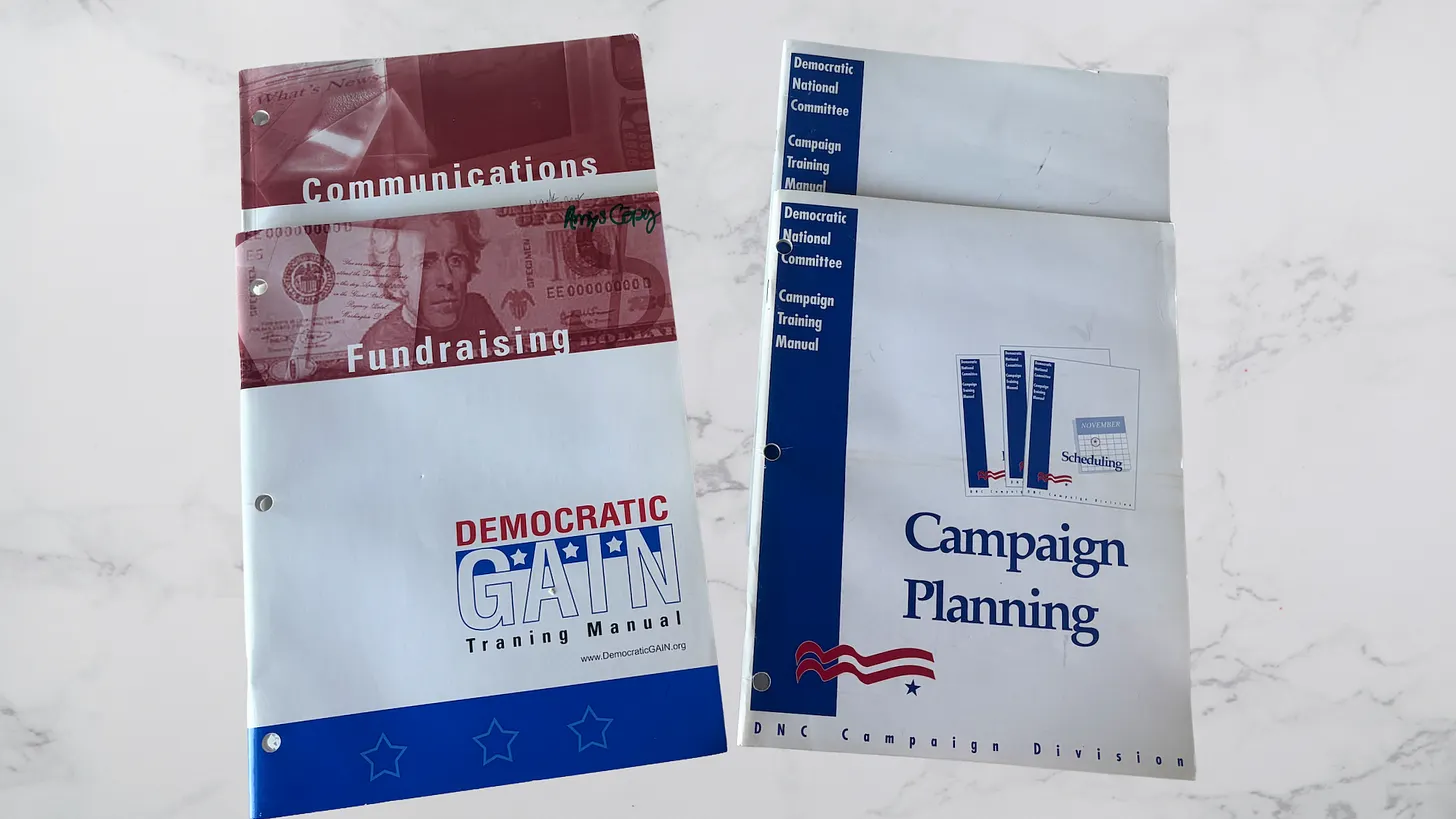
I've been thinking a lot about campaign training manuals lately, which probably isn't a sentence that inspires nostalgia for most people. It does for me. I could write a history book about them — and this is part of it.
I saw my first DNC campaign manuals in 1992. By the mid-'90s I wasn't just reading them — I was organizing the training rooms, first as a trainee and then as a trainer, working for the DNC through the big trainings in 1996 and 1998, and later through the Ron Brown–Paul Tully Institute, the DNC's training arm, named for two people who understood better than almost anyone that the party's real infrastructure was its people. Los Angeles. Kentucky. Baltimore. Charlotte. Cities that honestly blur together now. What doesn't blur is the people. Those rooms are where a huge number of people learned how campaigns actually work. They're where people found jobs and careers they didn't know existed, where friendships started, where future campaign managers met future organizers. A whole generation of political professionals learned this work from each other in those rooms, and they became an enormous part of my life.
But my own story in those rooms starts even earlier. In 1988, on the Dukakis campaign, I was trained through Project 500 — another program that deserves enormous credit in this history, because it launched not just my career but hundreds of others. One of the organizers and trainers that year was Will Robinson, who went on to become one of the most renowned trainers our field has ever produced. Thirty-eight years later, the person who first trained me is co-founding Democracy University with me — and co-authoring these new manuals. So when I say training rooms change lives, I'm not being sentimental. I'm describing my own. Rebuilding an institution takes Will — and I've got the best one in the business.
That tradition carried into the formation of Democratic GAIN. After a few years of building the organization from 2000 to 2003, we took on a big project in 2004: rebuilding the campaign training manuals that had grown out of the earlier DNC and EMILY's List materials, working with an extraordinary group of practitioners — Debbie Willhite, Susan Blad Seldin, Laurie Moskowitz, Marie Theresa Dominguez, Paul Tewes, Laura Quinn, Karen Kolber, Steve Rabinowitz, Bernard Craighead, Simone Ward, Jehmu Greene, and so many others. The result was seven manuals: Campaign Strategy, Communications, Fundraising, Technology, Volunteers & Activists, Voter Contact, and Administration & Legal.
I still look at the names of the people who wrote and edited those books and think about how much knowledge was sitting in that community. Many are still doing the work. Some became mentors to a new generation. Some are no longer with us. But their lessons are still here with us. I'm proud of how our community was committed to diversity then, but we're even more committed to diversity today — that is the strength of our community.
So what are we doing?
Will and I are launching Democracy University to rebuild this infrastructure — and the first big project we're co-organizing is rebuilding the manuals for 2026 and beyond. We're on draft 11. I expect there will be about 40 drafts before they feel right or ready, and I'm only half joking. We intend to make them living documents that can and must be updated regularly.
The collection has grown from seven manuals to twelve, and we're both working on more (so can you!) — and please remember these are just drafts now.
- Campaign Strategy
- Leadership
- Scheduling & Events
- Field & Targeting
- Organizing & Volunteers
- Communications & Persuasion
- Fundraising & Finance
- Data & Analytics
- Technology & Cybersecurity
- Campaign Operations
- Campaign Law & Ethics
- Digital Organizing & AI
The biggest change from the old books is that we're building these in a few forms. The manuals themselves are comprehensive — deep, long-form references meant to hold everything, from strategy frameworks to worked examples to trainer curricula. And from them, we're building bite-sized lessons — short, practical pieces built around stories, anecdotes, and lessons learned from people who have actually done the work. Less textbook-or-nothing, more master class.
We're using ethical AI tools to help us reorganize, synthesize, and pull together resources from an enormous range of contributors — and we say so directly in the manuals. AI is a tool in this process. It is also something we need to teach more about. The political wisdom comes from people.
What's changed, and what hasn't
In 2004, "technology" fit in one manual. Now it takes three: technology and cybersecurity, data and analytics, and digital campaigning, organizing, and AI. Social media transformed communications. Vote-by-mail and early voting changed the field. The information environment fragmented. AI is changing research, communications, administration, and probably a dozen things we haven't figured out yet.
But the fundamentals haven't moved. Time is still the one resource a campaign never gets back. Strategy still requires choices. Organizing is still about relationships, and leadership is still about people. A perfect voter file doesn't knock on a door. Those lessons get passed down — someone taught them to us, and it's our job to teach them to somebody else.
One more difference from the old books: the Democratic GAIN manuals were proudly partisan. Their whole purpose was to help campaign workers win. The Democracy University manuals are intentionally nonpartisan — useful for candidate campaigns, ballot measures, advocacy organizations, C3s, unions, and movements, regardless of party. That doesn't make strategy neutral. We're teaching the craft of campaigning, not how one party beats the other — but be clear, our values are baked in.
Here's the part we care about most
We don't want these to be Amy and Will's manuals. We don't even want them to be Democracy University's manuals. We want them to be our field's manuals.
Almost everything any of us knows came from somewhere else — a trainer, a campaign manager, a candidate, a volunteer, a terrible mistake, a win where everything suddenly clicked. We borrow, we test, we adapt, we argue, we improve. And if we're doing it right, we pass it on.
So here's the ask. If you like the idea of rebuilding these manuals — and want to be part of it — share your training story. A lesson learned. A tip. A piece of advice you've never stopped using. We're crowdsourcing to ensure we have diverse voices and perspectives.
If you helped create the old manuals, tell us what you remember. The story behind something we taught. What we got right, and what you'd throw out today.
If you learned from them, tell us what stuck. A lesson that followed you through your career. A training where you met someone who changed your life.
If you came up after that era, we especially want to hear from you. What do people entering campaigns today need to know that nobody taught us? What has our field learned? What assumptions from our generation should we challenge?
Send us the case study, the cautionary tale, the training exercise, the spectacular failure, the weird thing that somehow worked, the mentor's advice you've repeated for twenty years, the lesson you learned at 2:00 a.m. in a campaign office and never forgot. We want all of it. And of course you'll be credited.
And if you want to do more than share a story, donate. Your support brings not only the manuals to life, but the classrooms we'll teach them in. The training rooms changed my life. Help us build the next ones.
Our ambition is admittedly ridiculous: we want Democracy University to be a master class of democracy and politics — built not around one expert, but around generations of people who have done the work.
The old manuals changed my life. The people I met through those trainings changed it even more — the trainer I met in 1988 is building this with me right now. We get to take what that generation built, keep the best of it, challenge what needs challenging, add everything we've learned since, and hand something better to the people who come next.
If you were part of this history, help us remember it. If you're writing the next chapter, help us build it. And if we're forgetting someone who needs to be part of this — tag them. We're nowhere near finished.
Knowledge is power. And knowledge becomes infrastructure when we share it.
— Amy Pritchard